Showing posts with label staircases. Show all posts

Tuesday, 7 March 2017

Intelligent stairs - can it be done?

Intelligent stairs - can it be done?

Yesterday I wrote about local intelligence and the possibilities doors have in this respect. Today, reading yesterday's note, my mind turned to stairs - another building element that fascinates me. Why do I expect intelligence from doors and not from stairs? Why do I assume that stairs are to remain passive or even unyielding? Is it just that I'm used to dynamic behaviour in doors? There are automatic stairs, too; escalators that detect that someone is approaching and start rolling. Why does this impress me less than a door automatically opening to admit authorised persons on a biometric basis? Could it be so that I see stairs as a danger, something to be feared and treated with caution - and for that reason prefer them to be passive? 

It could be because intelligence in stairs may be far more demanding than in doors. Automatically adjusting the stair dimensions to the size and mobility of every user would certainly impress me but it wouldn't be easy to achieve, even if it were about a single user at a time. Stairs that could accommodate several users simultaneously in this manner would be a feat worthy of the highest praise for its ingenuity but, as societal or technological priorities go, not of the same order as a cure for any persistent illness. So, I fear that stairs are to remain relatively unintelligent, passive and a bit menacing - beautiful but rather dangerous. 

Tuesday, 28 February 2017

Validation, verification, design

Validation, verification, design 

I often find myself entangled in discussions on what a brief is, what it does, how a design is structured with respect to a brief and all kinds of rather unproductive situations. Many of them derive from my own stubborn interest in terminological clarity and consistency, which may conflict with established terms and their use. Nevertheless, I don't intend to stop. I see what happens in other areas and it makes me believe that terminological clarity is a good indication that an area knows what it is doing and why (methodological clarity and relevance). So, I wonder what we are doing in architecture to validate and verify a design.

To be clear about the terms I'm using, validation refers to whether the design solves the original problems and validation to whether the design meets the specifications set up for solving the problem. In other words, it goes like this: we identify a problem, then we set some specifications for the designs that should solve it and then we make designs on the basis of this specification. In architecture the specifications (the brief) are often put aside and designers address the problem itself. This may indicate poor specifications or bad designer attitudes; in either case, it's a sign of a poorly operating field. Both verification and validation are necessary when it comes to testing the utility of a design as well as establishing and extending domain knowledge.

A practical example: accessibility is an undeniably serious issue in architecture. To ensure accessibility in a design we have all kinds of rules and regulations that specify constraints on spaces and building elements like the width of corridors or doors. A design can be evaluated against such constraints and so verified as an adequate solution to accessibility. However, it is also important to see if the building is also accessible by really testing it with respect to the movement of people with disabilities or spatial needs. Validation can make evident that e.g. additional constraints are required or that some constraints contribute little. We shouldn't assume that the ones we have been using are right or sufficient. Just think of Blondel's formula for stair design, which is seldom if ever challenged: 2 x riser + tread = step length. Why do we assume that it suffices for the design of safe and comfortable stairs? My own experience tells me that if a tread is not deep enough for my 46-size shoes, descent can be a problem.

Saturday, 21 January 2017

Failure

Failure

We seem to measure failure in various ways. If a building fails to be comfortable or even safe (in minor ways, at least), we tolerate the discomfort or brave the danger of stairs with too shallow treads, even on a daily basis. We accept such things do happen with buildings and so also the exposure to some of their effects, just shrugging our shoulders stoically and going on with our lives. It's an attitude we adopt with quite a few artefacts, from shoes to computers. We may spend endless hours painfully breaking in shoes or trying all kinds of remedies for hardware or software problems - that's life.

On the other hand, failure in an airplane or a medical operation seems unacceptable. One would say that what matters is how critical a failure can be. That a train fails to appear, making the next one too crowded is different from a collision of the two trains. I accept that but also wander about the mathematics of it: is it more dangerous to descend a bad stairway a few times every day or to fly to a holiday destination once a year?

In the end, what concerns me is avoidable failure: like in team sports, I want to reduce the errors I make without external reasons. We have to be aware of why and how we may fail and take steps against it. There's no excuse for not doing so, even if others keep on failing.

Friday, 6 January 2017

Transparency makes a difference

Transparency makes a difference 

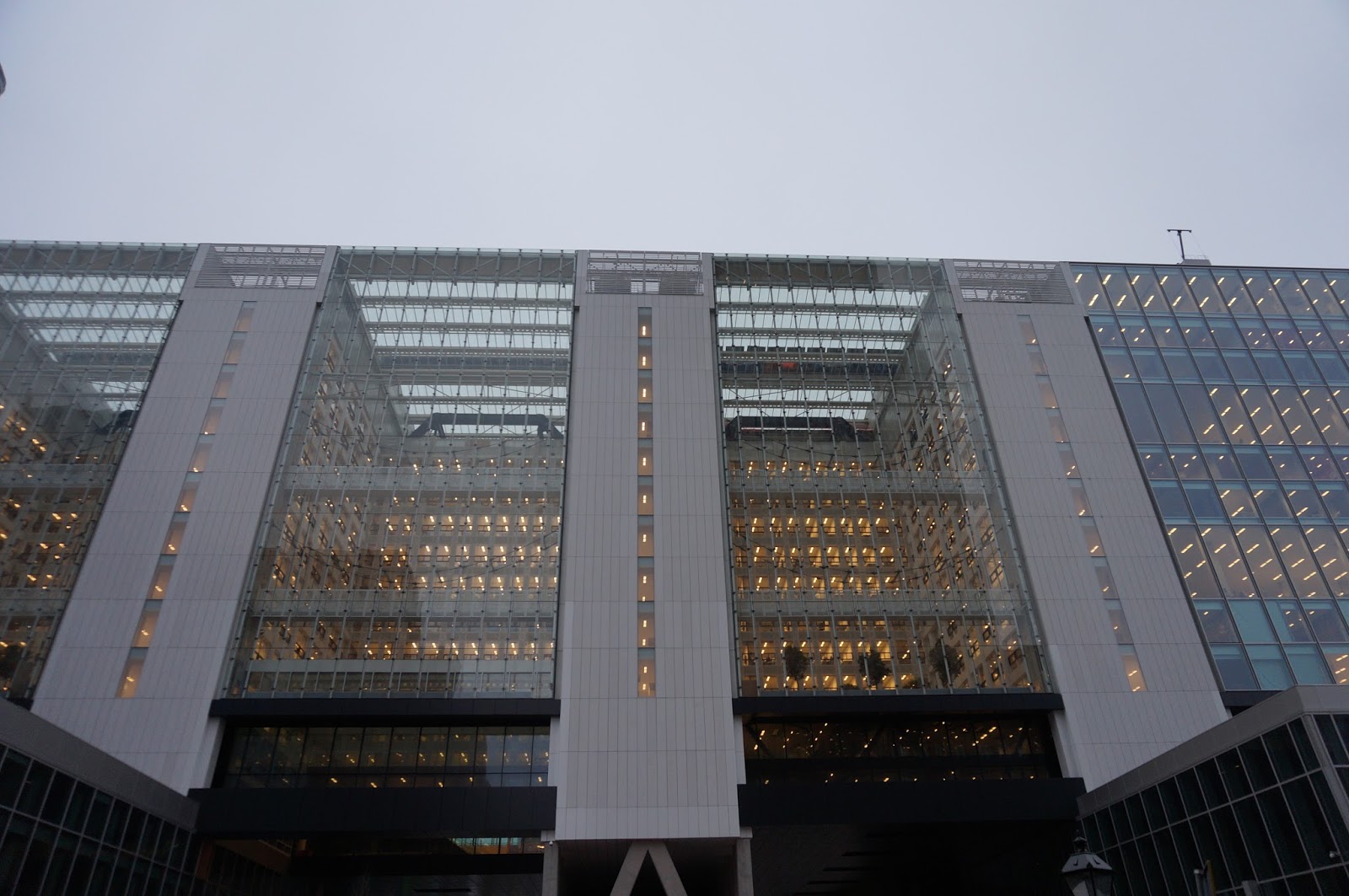
It's fun going back to a building one used to know after a refurbishment; it's even more fun to visit during the refurbishment. It used to be an odd building, a contradictory combination of generous, sunny and light communal spaces and small, dark, almost claustrophobic office wings. Now the former VROM ministry building by Jan Hoogstad at Rijnstraat 8, The Hague, is about to begin its second lease of life, as the renovation on the basis of a design by OMA (in collaboration with Hoogstad) is almost complete. When the contractor organised a visiting day, I couldn't miss the opportunity.


Quite a lot has changed (including the vertical circulation cores) but nevertheless many features of the original design remain recognisable. There's lots of glass everywhere; almost all internal partitions are now transparent, affording some daylight even in deep in the building as well as nice views of the city centre around (not that everything you see is necessarily beautiful) but these will be probably reduced once people and their stuff clutter up the building (by the way, lots of furniture is already in the building, collecting dust from the building activities - some logistic cockup?).


Strangely, the new stairs have a rather shallow tread. I wonder if it's according to building regulations and even more when architects will learn to design stairs without blindly following established nonsense like Blondel's formula and use their own eyes and feet to measure things. My 46-size shoes don't fit on these treads.


One thing I don't miss is the old radiators, which used to hang at illogical positions behind the curtain walls (even at eye height or higher); everything is now hidden in the floor or the ceiling. Thankfully, the designers appear to have added a couple of other jokes.


Leaving the building I'm struck by the questionable entrance, especially the relative position of the two sets of revolving doors. I'll have to come back once the building is in operation to see how it goes.


Monday, 12 December 2016

Montagne de Bueren

Montagne de Bueren, Liège, Belgium

Liège is not a city I've ever considered exploring, learning and appreciating its pleasures. I've passed it many times on the way to and from the Ardennes but it was only this autumn that I decided to stop and see something of the city. Having just six hours at my disposal, I'd made a note of a couple of apparently decent restaurants for lunch and a couple of museums with local themes. In the end I visited just one place, the one on the top of my short list: the Montagne de Bueren.

Liège did not disproved expectations as the car moved from the Ardennes highway to the city centre: everything seemed drab and tired; lively on a Sunday morning but uninspiring. I parked the car at the first available spot near my destination, much to the frustration of several cars behind me, who weren't thrilled at the good luck of a vehicle with Dutch number plates. For about five minutes I walked along a street that didn't even give a single sign of former glory but suddenly I saw to my right the 374 steps, bathed in the pale light of the misty noon.


Climbing the stairs was a transition in time, from the disappointing present to past decades reflected in the morphology of buildings that were often in poor repair but nevertheless quite joyful as they perched on their plots enjoying the sunshine and the view. The air remained misty but even so it was clear why people braved the discomforts of living along a steep stairway.


The Citadelle at the top of the hill was little more than a colourless urban park. With delight I left it largely unexplored and returned to descend the Montagne. The only thing I regretted was the growing number of tourists. Perversely, I always expect to be the only one among the locals.


Wednesday, 7 December 2016

Tiger & Turtle

Tiger & Turtle, Duisburg 

On the flat top of a green hill with all the charm of a suburban playground, overlooking a rather drab industrial landscape but also affording a panorama dominated by dense trees behind which you can catch glimpses of the residential neighbourhoods of Duisburg, stands a strange and impressive sculpture: a staircase with varying pitch, including a couple of loops, that undulates along illogical lines like the ribbons of rhythmic gymnasts.


I stopped there on my way to Cologne, curious to see the amazing staircase with my own eyes, eager to climb its entire length - how many can boast they've walked upside down on a staircase, closing a full loop?


The ascent to the hill with various views of the Tiger & Turtle did not disappoint. The staircase itself was a different matter. You can walk around it, under it and start walking on it but when the pitch starts becoming really steep and hence interesting, you encounter an abrupt termination in the form of a closed gate that prohibits any attempt at upside-down stair-climbing. The loops are inaccessible - not a staircase but a mere sculpture, after all.


Disappointed I didn't even put a foot on a single tread.

http://www.duisburg.de/micro2/tat/